
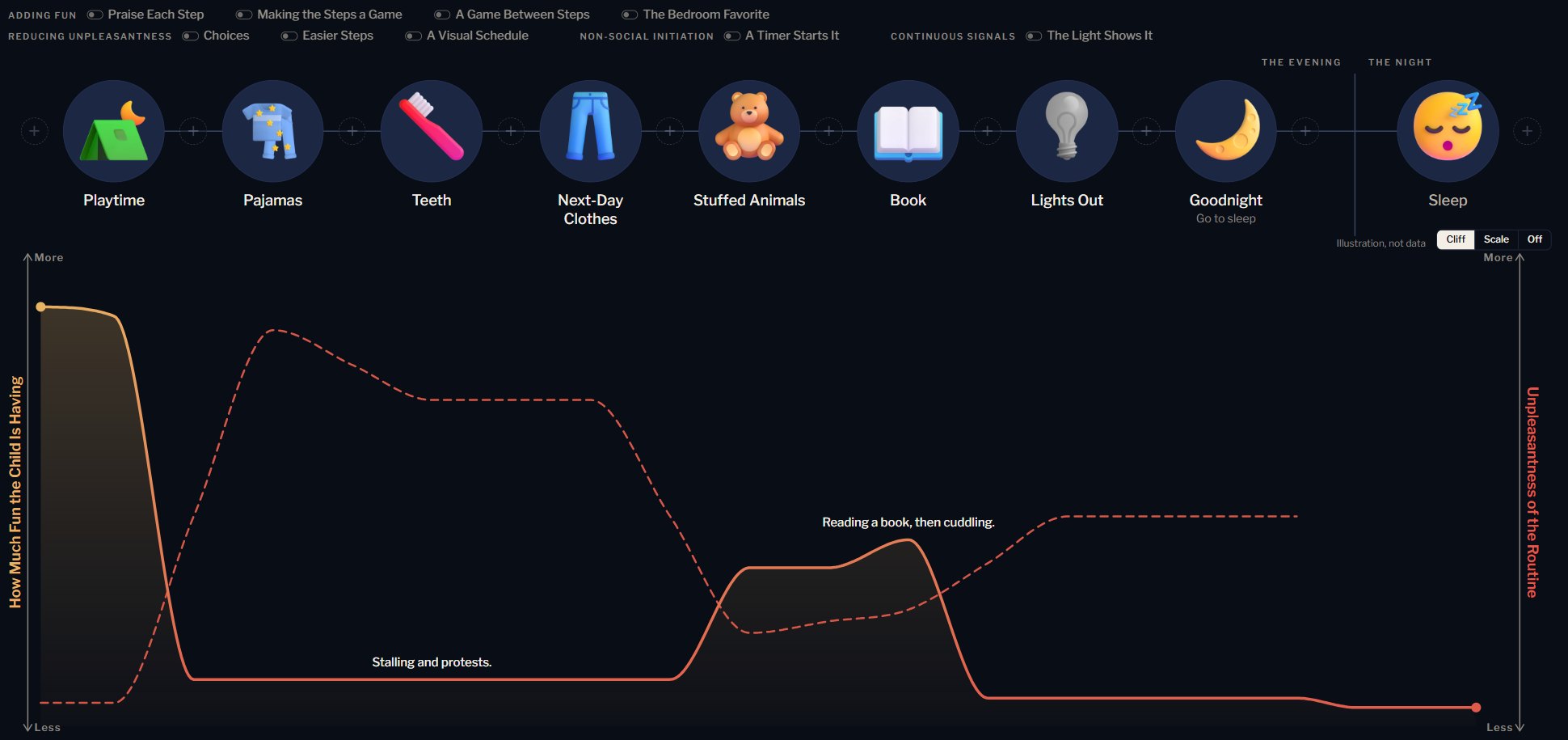
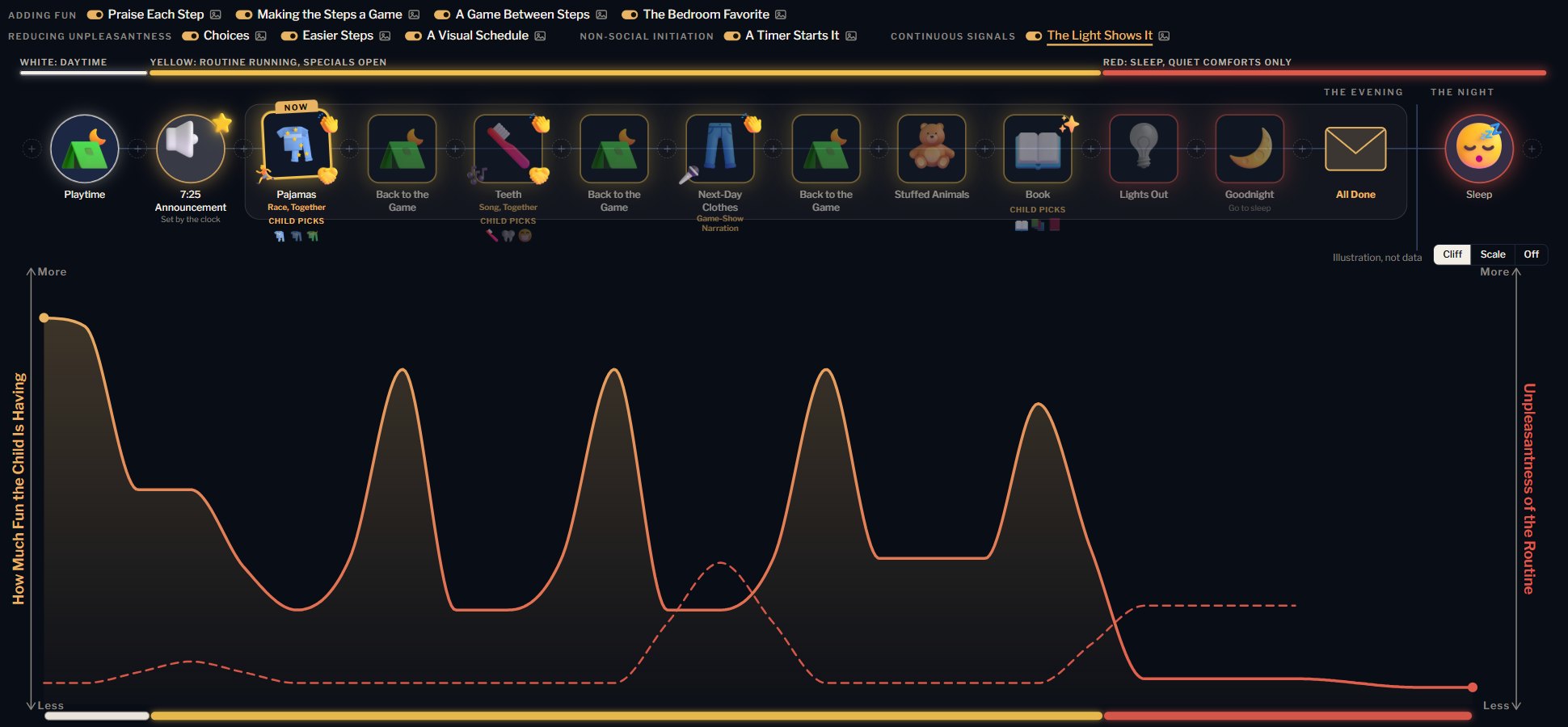

Carry the fun through the routine.
Nine switches, grouped under four headings, so the routine stops depending on the caregiver's instruction.
- Add Fun
- Reduce Unpleasantness
- Non-Social Initiation
- Continuous Signals
Leave able to rebuild any family's evening so that the child's behavior at goodnight is compatible with sleep, with the method and the tool to hand a parent on Monday.
Sleep is a state, and reinforcement cannot change a state directly. We arrange the evening so the child's behavior at goodnight is compatible with falling asleep. That sentence is the whole talk.
Every tactic has a published source, and the ones with weaker evidence are labeled that way on the slide. What happens after goodnight, when the caregiver leaves the room, is its own session.
Nine switches, grouped under four headings, so the routine stops depending on the caregiver's instruction.

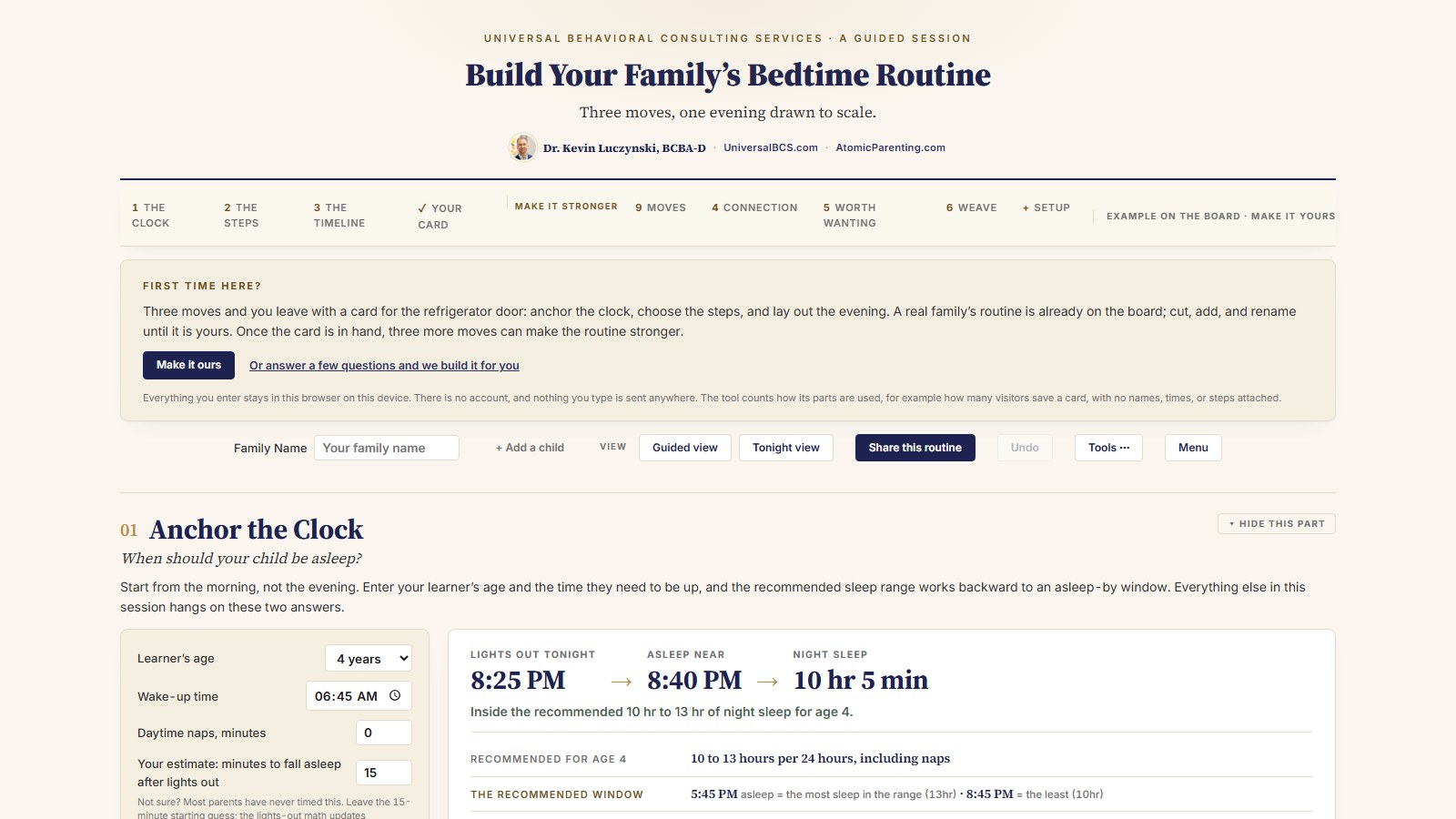
The talk's family goes into the Bedtime Routine Builder in three moves, and the session ends with the card a parent takes home.
A five-year-old, lights out at 7:45 PM, awake at 6:45 AM. Their evening is on screen as a chart before any tactic is named, and the chart comes back after every change.
Put one family's routine on screen, show the parent where the drop is, and name the behavior at the drop as learned, not stubborn.
Carry the fun through the routine with nine switches under four headings, and mark the point after which every step happens sitting or lying down with the lights down.
Build it in the Bedtime Routine Builder, in a browser, in words the parent can repeat: sleep-friendly and sleep-blocking beside the clinical terms. You watch one built live in the session.
bedtime-builder.vercel.app
Kevin treated learners with severe problem behavior at the Kennedy Krieger Institute, earned his doctoral degree under Dr. Gregory Hanley at Western New England University, and spent the following decade at the University of Nebraska Medical Center's Munroe-Meyer Institute, where he mentored 11 doctoral students. In 2023, he founded Universal Behavioral Consulting Services.
He has over 30 publications, nearly all in the Journal of Applied Behavior Analysis, and studies the in-home treatment of pediatric behavioral sleep problems.
Kevin has treated children's sleep problems throughout his career. These four steps, over the last two years, led to this hour.
Kevin and his wife, Dr. Nicole Rodriguez, wrote Pediatric Sleep: A Behavioral Account for the second edition of the APA Handbook of Behavior Analysis, edited by Dr. Gregory J. Madden and Dr. Florence D. DiGennaro Reed. The chapter is in press as Volume 3, Chapter 17.
The chapter led to a collaboration with Dr. Derek Reed on Sleepy Star: A Children's Book as a Bedtime Aid for Parents. The routine steps are written into the story, so reading the book together is part of the treatment for bedtime resistance.
Kevin presented the routine work to behavior analysts and asked the audiences for feedback.
After two talks at the Minnesota Northland Association for Behavior Analysis, attendees told Kevin the material could help more clinicians and that he should make it available. This webinar does that.
“I was blown away by your talk at Minnesota ABA, and I appreciate the materials and strategies that you shared. It inspired me to reevaluate whether there are sleep concerns with the clients I serve.”
“I had no idea who Dr. L was before his Two Sleeps talk. Now I want to hear more of his stuff. He was entertaining, and everything he talked about could be used with clients tomorrow.”
“Sixty minutes flew by really quickly. So enjoyable. Every clinician should see Dr. L’s sleep talks.”
Two runs of the same hour. Choose the one that fits, pay, and the Zoom link arrives by email. If the date does not work, email Kevin to ask about an asynchronous option.
Card payment through Stripe at registration. No refunds. CEUs require live attendance, verified with code words shown during the hour.